
The Unexpected Gift of Silence
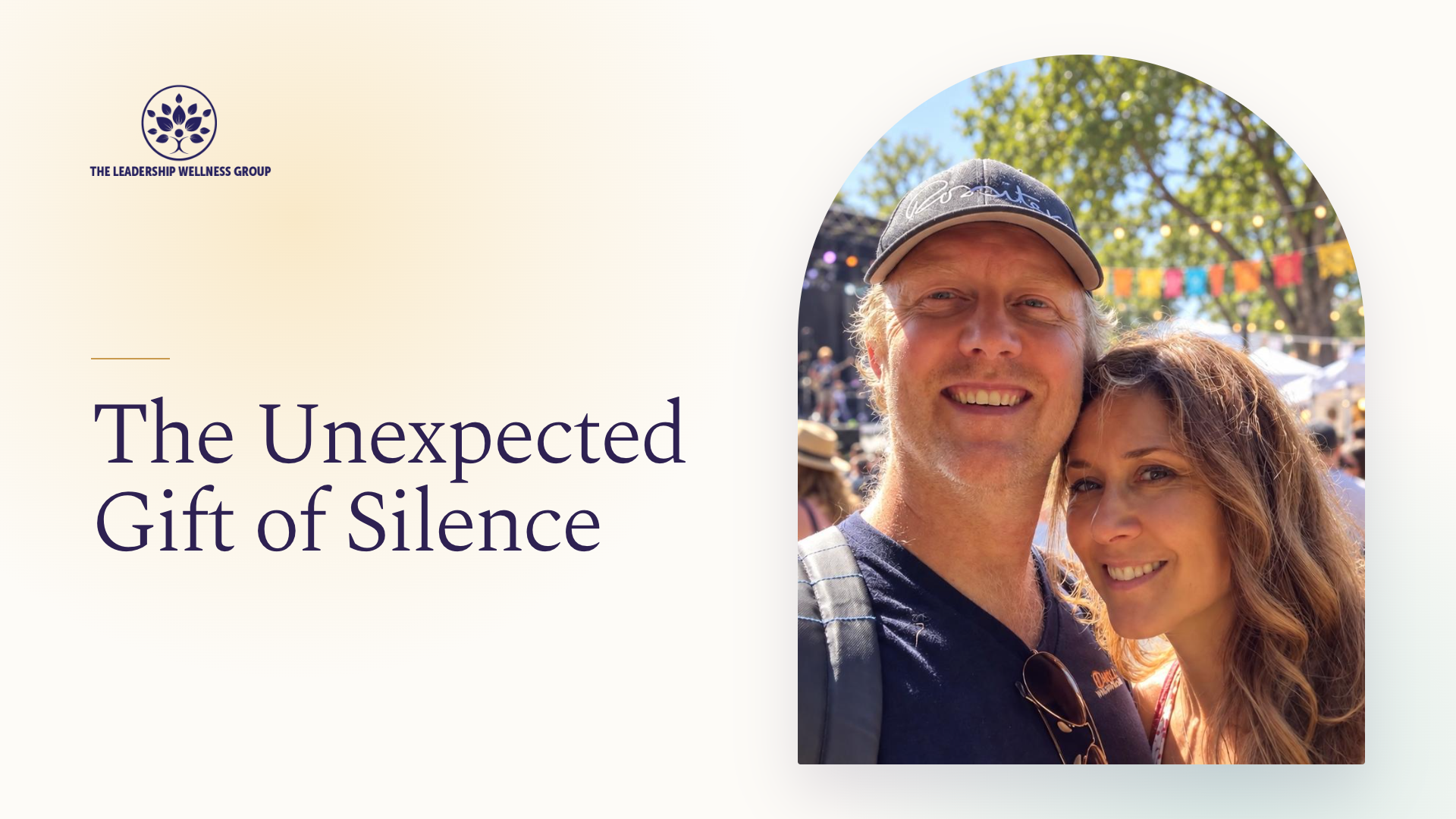
A few weeks ago, my husband, Aubrey, and I were enjoying a beautiful afternoon at a street festival in Toronto. The sun was shining, the weather was warm, and there was a wonderful sense of joy and community in the air.
There were five different bands performing, outdoor markets, delicious food, and people everywhere. We ran into friends and neighbours, spent time with their children, and even struck up a conversation with another couple who joined our table because the festival was so crowded.
It was one of those lovely, spontaneous afternoons when life feels especially good.
After dinner, we said goodbye to our friends and decided to make our way to one of the stages to dance. As we walked through the crowd, someone bumped into me. I thought nothing of it. It was a busy festival, and people were brushing past one another everywhere.
Aubrey, however, noticed something suspicious and asked me to check my pockets.
My phone was gone.
I knew immediately that it had been stolen because I had just used it to text one of my daughters moments before leaving the restaurant seating area.
What happened next felt like a scene from a movie. Because Aubrey and I share our locations through Apple’s Find My app, he could see where my phone was moving. He grabbed my hand, and we started running through the crowds, following the location of my phone.
At one point, concerned about confronting the thieves ourselves, we enlisted the help of two rather large restaurant servers who joined us in the pursuit. We followed the signal until it led us toward a church, where the people we were following suddenly disappeared inside.
For a moment, I felt as though we were in a scene from a thriller. Then the signal vanished. They had switched off my phone.
When we spoke with the police, they told us that at least ten other phones had already been reported stolen at the festival that afternoon. Clearly, these people knew what they were doing.
As far as life’s challenges go, having a phone stolen is an annoyance, not a disaster. Nevertheless, it was a rather expensive and frustrating one!
Like so many of us, I had practically my entire digital life stored on that little device. My contacts, photographs, emails, passwords, notes, apps, and even recordings of breathing practices I had created for my coaching clients were all connected to it.
To make matters worse, I could not remember my Apple ID password. When I contacted Apple, I learned that it would take approximately six days to verify my identity and restore access to my account.
Six days!
I had to shut down accounts, replace my phone, and absorb the considerable financial cost. What I did not know was that those six days would turn out to be an unexpected gift.
The six days I didn’t know I needed
The very next day, I learned that my mother was seriously ill. What began as the flu had developed into severe pneumonia, with concerns about complications involving her heart. Her condition had deteriorated significantly, and I needed to be with her.
I travelled to my parents’ home and spent the next six days helping to care for them and navigating the frightening uncertainty of my mother’s illness.
These were the very same six days that Apple needed to restore access to my phone.
I had a replacement phone, but it was little more than a device for making calls and sending text messages. I had almost none of my contacts, no email, no familiar apps, no podcasts, no Spotify, and no YouTube. Even when someone texted me, I often had no idea who it was because their name was no longer attached to their number.
For six days, the endless stream of information, communication, and entertainment that normally accompanied me everywhere simply stopped.
I drove in silence. I sat in silence. I spent time with my mother and father without the familiar pull of a device beside me.
Of course, I would have been present for my parents regardless. Yet I began to notice something that surprised me. Despite the enormous stress and uncertainty surrounding my mother’s health, I felt remarkably calm.
I was not constantly anticipating the next message, checking an email, or reaching for my phone whenever there was a quiet moment. There was simply more space to think, to feel, to notice, and to breathe. Most importantly, there was space to be fully present with the people who needed me.
What began as an unwanted disconnection from my digital world became an unexpected reconnection with the world right in front of me.
How much of the noise are we creating ourselves?
I have spent years studying, teaching, and practising resilience, mindfulness, and nervous system regulation. I understand the importance of slowing down, cultivating awareness, and creating space between stimulus and response. I have a daily practice of yoga, meditation, and breathwork.
Yet this experience made me realize how easily I had fallen into the habit of filling every available moment. A podcast while driving, music while cooking, a quick check of my phone between meetings, a message answered while waiting in line, or a few minutes of scrolling whenever I had nothing in particular to do. Individually, these moments seemed harmless. Collectively, they meant that very little of my day was actually quiet.
We often talk about teenagers and their relationship with technology. We worry about the generation of “screenagers” growing up with smartphones in their hands. I had to laugh at myself. To what extent had I become a screenager too?
How often was I reaching for my phone without any real intention? How often was I filling a moment simply because it was empty?
We live in a world that is increasingly loud, fast, and demanding. Our calendars are full, our inboxes never seem to empty, and information is available to us every second of every day. While we cannot always control the demands around us, I began to recognize how much of the noise I was adding myself.
We say we long for more time, more peace, and more spaciousness. Yet how often do we fill the very spaces that could give us those things?
What science tells us about silence and our nervous systems
There is a growing body of research exploring the relationship between digital technology, attention, and well-being.
A fascinating 2025 study published in PNAS Nexus explored what happened when people blocked internet access on their smartphones for two weeks while retaining the ability to make calls and send text messages.
Researchers found improvements in sustained attention, mental health, and subjective well-being. Among participants who completed the intervention, 91% improved on at least one of those measures. Interestingly, participants also spent more time connecting with others in person, exercising, and being outdoors.
In other words, when we remove some of the constant digital input, we do not simply create an absence. We create an opportunity for connection, reflection, movement, creativity, and rest.
There is also research suggesting that silence itself may influence our physiology. A 2006 study published in the journal Heart found that a two-minute pause between musical selections was associated with reductions in heart rate, blood pressure, and breathing activity.
Although we are still learning about the physiological effects of silence, these findings invite us to consider how moments of quiet may support relaxation and nervous system regulation.
From a resilience perspective, this is particularly meaningful.
Our attention and energy are finite resources. When we constantly switch between messages, notifications, information, and tasks, we place additional demands on those resources. Creating moments of quiet gives us an opportunity to settle our attention, notice our internal state, and replenish some of the resources we draw upon when life becomes difficult.
Silence will not feel calming for everyone, particularly at first. Sometimes it brings us face-to-face with thoughts and feelings we would rather avoid. Yet learning to be with ourselves, without constantly reaching for distraction, can be a powerful practice in cultivating awareness and strengthening our capacity to respond rather than react.
This is one of the fundamental principles of resilience that I teach. Resilience is not only about how we respond when life becomes stressful or difficult. It is also about how we manage our energy, protect our attention, and create the conditions that allow us to respond well in the first place.
Building resilience is not always about adding more tools, techniques, or habits to our already full lives. So often, it is about learning what not to do. It is about knowing when to say no, simplifying our lives, creating space, and recognizing what we need to release or take away.
Sometimes, creating greater capacity is not about doing more. It is about making room for less.
Looking back, I wonder how much the absence of constant stimulation contributed to the calm I experienced while caring for my mother. I cannot know for certain, but I know how I felt. I was less scattered, less pulled in a hundred directions, and more grounded in the present moment.
In the midst of a very challenging week, silence had become a resource I had not even realized I was missing.
Creating space is a practice
When Apple finally restored access to my account, I was relieved to recover so much of my digital life. Yet I realized that I did not want to return to my old habits. I wanted to preserve some of the spaciousness I had discovered.
Since then, I have started leaving my phone in another room rather than carrying it everywhere. I turn it off more often, and sometimes, when I drive or walk, I deliberately choose silence instead of automatically reaching for music or a podcast. I have also become more aware of that almost unconscious impulse to reach for my phone whenever there is a pause in the day.
I have noticed a real difference. I feel calmer, less distracted, and more present. I am remembering that not every moment needs to be productive, entertaining, or filled with information. Sometimes it can simply be a moment.
This experience reminded me of a wonderful book a friend shared with me, How to Break Up With Your Phone by Catherine Price.
The book is not about abandoning technology. It is about developing a more intentional relationship with it, one in which we decide how to use our attention rather than allowing our devices to continually decide for us.
Catherine also offers a free Phone Breakup Starter Kit with practical resources to help us create a healthier relationship with our screens. I encourage you to explore it.
An invitation to create a little more space
As you move through the coming week, I invite you to experiment with creating a little more silence. You do not need to lose your phone, disappear into the wilderness, or commit to a major digital detox.
Perhaps you could leave your phone in another room while enjoying a meal, take a walk without listening to anything, or drive somewhere without automatically turning on the radio. You might even experiment with allowing a few quiet moments between meetings rather than immediately checking your messages.
When you notice the familiar urge to reach for your phone, pause for a moment and ask yourself:
What am I reaching for right now?
Is it information, connection, entertainment, or a distraction from something uncomfortable? Or is it simply a habit?
Notice what happens if you allow that moment to remain unfilled. Pay attention to your breathing, your body, and what is happening around you. You may initially feel restless or uncomfortable, and that is perfectly natural. Over time, you might discover that these small moments of silence offer something far more nourishing than another piece of information or another distraction.
This is how we begin to create new habits, one small moment of awareness at a time.
We often think of resilience as our capacity to navigate life’s challenges and uncertainties. Yet resilience is also about how we replenish ourselves, protect our attention, and cultivate the inner resources that allow us to meet life with greater presence, clarity, and ease.
I certainly would not have chosen to have my phone stolen, nor would I recommend the experience! Nevertheless, I am grateful for what those six days taught me.
In losing my connection to so much of the outside world, I discovered how nourishing it can be to reconnect with the present moment.
That is a gift I intend to keep.
One more thing. Let’s reconnect!
There was one part of this experience that was not quite so wonderful. When my phone was stolen, I also lost a number of messages and conversations that I have not been able to recover.
If you reached out to me over the past few weeks and I never responded, please do not take it personally! Your message may simply have disappeared along with my phone, and I would genuinely love to hear from you again.
I would also love to know what this story brings up for you. How often do you find yourself reaching for your phone without thinking? What might you discover if you invited a little more silence and spaciousness into your life?
Perhaps we can all give ourselves permission to disconnect a little more often so that we can connect more fully with ourselves, with one another, and with the lives unfolding right in front of us.
With warmth,
Monica
P.S. If this reflection resonates with you and you would like to explore how we can cultivate greater resilience in ourselves and others, I invite you to join me for my free webinar, Beyond Bouncing Back: The Art and Science of Coaching Resilience. We will explore practical, evidence-informed approaches to building resilience and how to bring them into our lives, leadership, and coaching. [REGISTRATION LINK TO BE ADDED]
Enhance your coaching practice with proven strategies and transformative tools to empower others and inspire thriving outcomes.
Download Beyond Bouncing Back: A Guide for Coaching Resilience in Your Clients, Your Staff & Yourself.