
The Power of Asking a Better Question
I recently finished a coaching session with a client who is incredibly capable, accomplished, and thoughtful. She is someone who manages a great deal, both personally and professionally, and has been navigating some significant challenges in her life.
When I asked her what was present for her and what she wanted to explore in our session, she began sharing a series of questions that had been running through her mind.
“What’s wrong with me?”
“Why can’t I figure this out?”
“Why does this keep happening to me?”
“Why can’t I seem to move forward?”
As she spoke, I noticed something. It wasn’t just the challenges she was facing that were weighing on her. It was also the questions she was asking herself about those challenges.
As coaches, much of our work involves asking powerful questions that help people gain new perspectives, discover their strengths, and see possibilities they may not have considered.
So we began exploring some different questions.
We spend so much time trying to find better answers. Perhaps we need to spend more time asking better questions.
Our questions shape our reality
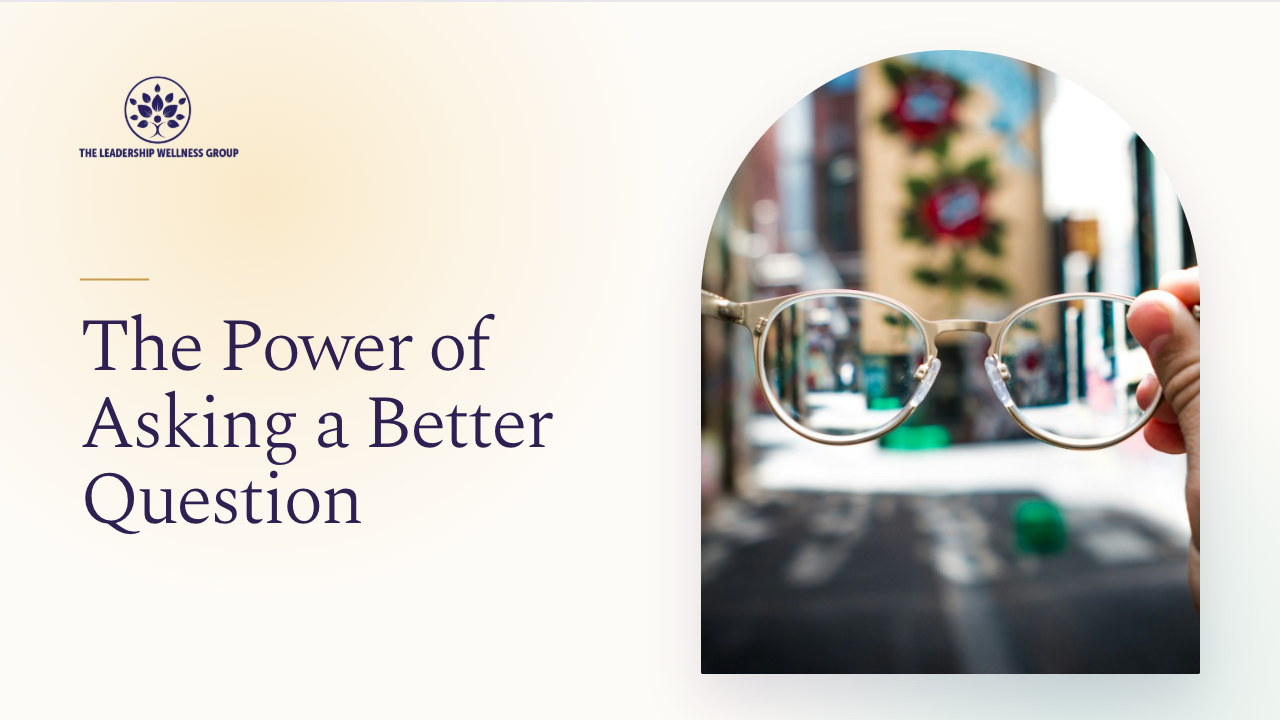
Think of questions as a pair of glasses.
Every question we ask creates a lens through which we see ourselves, other people, and the world around us.
When we ask questions focused on what’s wrong, our attention naturally turns toward problems, shortcomings, and obstacles.
When we ask questions focused on our strengths and possibilities, we begin noticing resources and opportunities we may have overlooked.
Our circumstances haven’t necessarily changed, but the lens through which we’re looking has.
We tend to move in the direction of the questions we ask.
This is one of the foundational ideas behind Appreciative Inquiry, a strengths-based approach to change developed through the work of Dr. David Cooperrider and Dr. Suresh Srivastva at Case Western Reserve University.
At its heart, Appreciative Inquiry invites us to shift our attention from what’s wrong or missing to what’s working, what’s possible, and what we want to create.
There’s a wonderful story from the field of Appreciative Inquiry that illustrates this idea.
British Airways was struggling with a baggage problem. Passengers and their luggage weren’t always arriving together, and the organization was focused on finding ways to fix the issue.
Rather than simply asking, “How do we solve our baggage problem?” the Appreciative Inquiry approach invited a different question:
“How might we create an exceptional arrival experience for our passengers?”
Notice the difference.
The first question focuses on fixing a problem. The second opens up an entirely new world of possibilities.
It doesn’t ignore the baggage problem. It expands the conversation beyond it.
While Appreciative Inquiry has been used extensively in organizations and teams, one of its most powerful applications may be in the conversations we have with ourselves.
What does this have to do with resilience?
When we’re overwhelmed, stressed, or feeling stuck, our questions often become narrow, much like the questions my client was asking herself.
These questions are understandable. When we’re under stress, our nervous system can shift into a more reactive state, making it harder to access the broader perspective, creativity, and flexibility that help us navigate challenges.
There’s an important principle from neuroscience: What we focus on grows stronger.
When we continually focus on what’s wrong, what’s missing, or why we can’t do something, we can reinforce patterns of helplessness and defeat.
When we begin asking questions that direct our attention toward our strengths, resources, and possibilities, we create opportunities to think and respond differently.
Of course, asking better questions doesn’t mean ignoring our problems, pretending everything is wonderful, or searching for a silver lining in every difficult situation. Challenges are real, and sometimes life is genuinely hard.
Resilience is about developing the capacity to navigate those challenges without becoming completely defined or consumed by them.
From feeling stuck to becoming a deliberate creator
Let me come back to my coaching client.
During the session, we reframed her questions one by one and paused to let her answer each new question.
Instead of “What’s wrong with me?” we explored, “What strengths can I bring to this situation?”
Instead of “Why can’t I figure this out?” we asked, “What might help me move forward?”
Instead of “Why does this keep happening to me?” we explored, “How might this be happening for me? What am I learning? What might be the gift in this experience?”
Instead of “Why can’t I seem to move forward?” we asked, “What would an exceptional outcome look like?”
As she began exploring and answering these new questions, something remarkable happened.
Her whole energy shifted. She sat up straighter, began smiling, and started speaking with more excitement and enthusiasm. Suddenly, she was seeing possibilities she hadn’t been able to see just moments earlier.
She began generating ideas, identifying actions she wanted to take, and talking about what she wanted to create next. She was energized and ready to move forward.
She had shifted from feeling like a victim of her circumstances to becoming a deliberate creator of what was possible.
Her circumstances hadn’t changed. The challenges were still there. What had changed was the lens through which she was looking at them.
A question to leave you with
Think about something in your life that feels challenging right now.
Take a moment to notice the questions you’ve been asking yourself about it. Perhaps even write them down.
Now, look at those questions and consider how you might reframe them to focus on your strengths, resources, or what’s possible.
What might change if you simply asked yourself a better question?
You don’t need to have the answer right away. Sometimes, a new question is all it takes to begin seeing things differently.
With love,
Monica
Continue the conversation
If this resonates with you and you’d like to explore how to cultivate resilience in yourself and others, I’d love to invite you to take the next step.
Join my free webinar: Beyond Bouncing Back: The Art and Science of Coaching Resilience.
This interactive 90-minute experience explores practical ways to strengthen resilience and support others in navigating stress, uncertainty, and change.
Explore the Certified Resilience Coach Program.
Discover our 12-week program offering 36 ICF Continuing Coach Education credits, designed to help coaches and helping professionals deepen their own resilience while developing the skills to coach resilience in others.
Learn More About the Certified Resilience Coach Program
Interested in working together?
If you’re navigating change, feeling stuck, or ready to explore what’s possible in your own life or leadership, I invite you to book a complimentary coaching conversation.
Book a Complimentary Coaching Conversation
Enhance your coaching practice with proven strategies and transformative tools to empower others and inspire thriving outcomes.
Download Beyond Bouncing Back: A Guide for Coaching Resilience in Your Clients, Your Staff & Yourself.